
Over the three-day holiday weekend for dragon boat festival we went to Macau. Macau is around 40 miles from Hong Kong. Last year during Dragon Boat festival we went to Hong Kong (I still need to post that blog entry… it has been half written for a year!), so this time we decided to go to Macau. Part of the reason is flights are cheap and it is a short flight.
It seems when you talk about Macau people only seem to mention the casinos. I read that the casinos employ 1 in every 5 people in the city and generate 7 times the wealth of Las Vegas. While the opulence is evident at the casinos, Macau’s colonial roots made the city feel like nothing I have seen in Asia so far.
The Portuguese settled in Macau and had control until 1999. This influence has made Macau distinctly unique. We stayed in Taipa, which is an island off the Macau peninsula. It is all connected by bridges and they have even created land for the airport and the Cotai strip where most of the casinos are located. Taipa has an old colonial village and the architecture reflects these historical roots. The street signs are translated in both Chinese and Portuguese. The city’s European influence makes it seem like you are no longer in Asia.
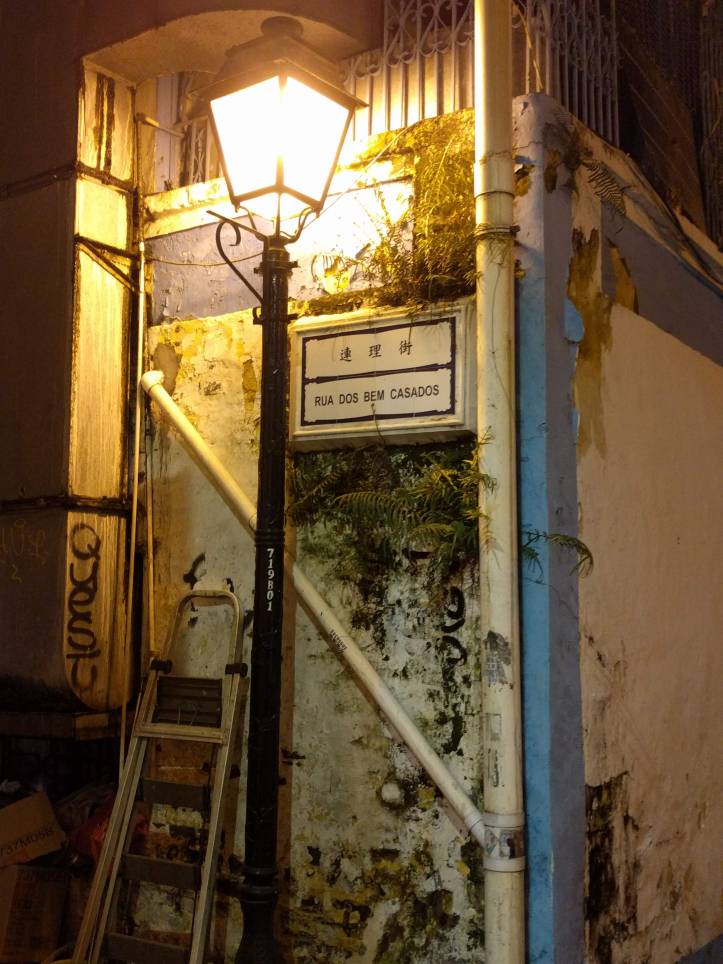
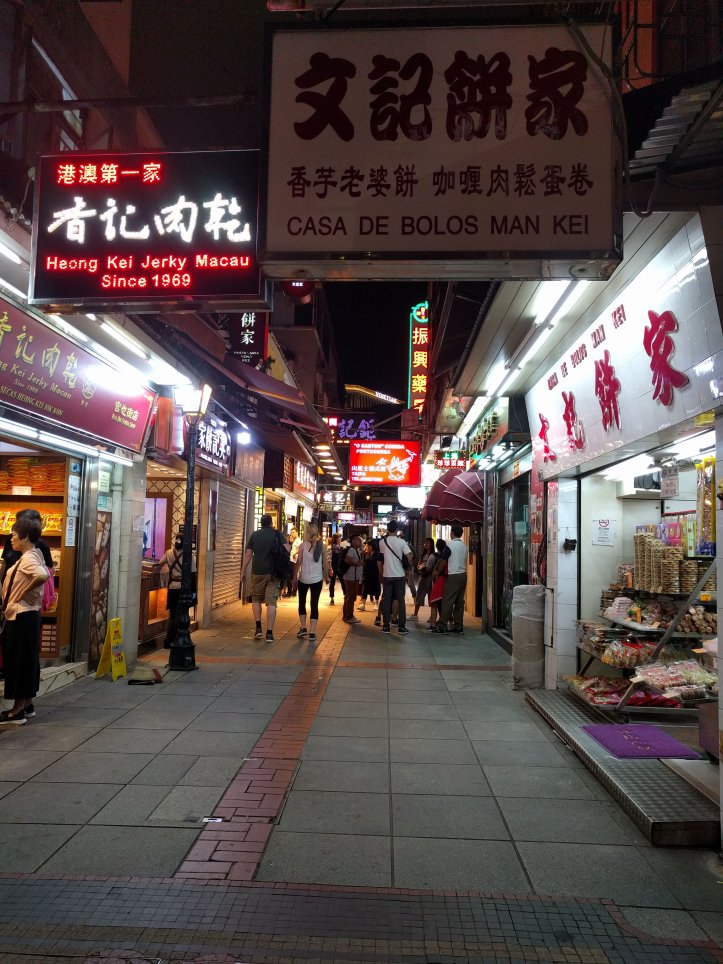
Macau is a funny place, outside of the casinos and sometimes even within the casinos they do not speak much English and the main language spoken is Cantonese not Mandarin. Portuguese is also spoken, but by small minority of the population. It was funny to know that even now with our slightly improved Mandarin we would not necessarily be understood. That being said with our broken Mandarin and English we got around just fine.
This European Asian influence has a wonderful fusion happen when it comes to the food. All we did was eat! I have a newfound appreciation for Portuguese style food. Lots of French bread, olives, olive oil, and carafe after carafe of sangria. If you go to Macau we recommend that you eat… everything.
Before arriving in Macau some friends of ours recommended the hotel where we stayed and told us there was a great coffee shop across the street with real doughnuts! I normally would not get so excited about doughnuts, but living in Taiwan there are things you don’t realize that you miss until given the opportunity to miss them. Cakes in general in Asia have that fluffy air feel to them. Which is great if you like that. I on the other hand love a good cakey dense doughnut. These doughnuts did not disappoint and make me look forward to eating another this summer in the States. It was also our first taste of Macanese/Portuguese egg tarts. Egg tarts are popular in Asia, essentially it is egg custard in a pastry shell. We have tried many good egg tarts, but the version here is different. Imagine flaky croissant dough instead of pie or cookie crust and a sweet eggy custard in the middle. That is what these are. I cannot really eat a lot of it as the lactard I feel unwell after, but I did appreciate the two I tried at first. D of course was very excited to eat as many egg tarts as possible and did end up bringing a half-dozen home with him.
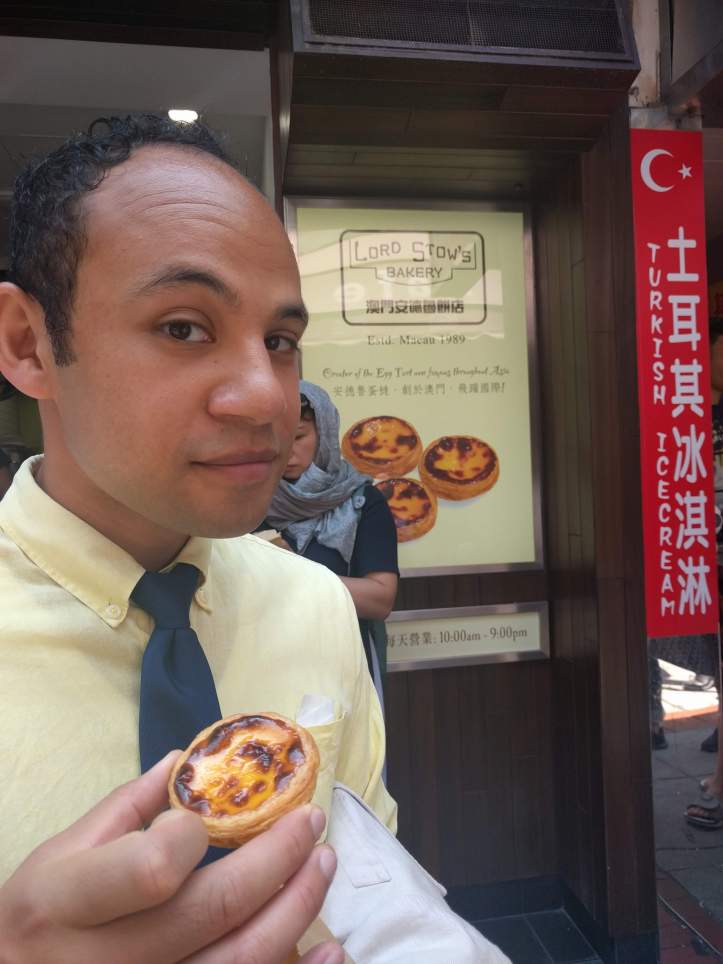
Every night we had Portuguese food for dinner and sometimes we had two dinners. A meal in one place and tapas in another. The mainstay of my evenings was a carafe of sangria. The popular items of Portuguese food include grilled whole sardines, feijoada, clams, potatoes, and pork. The most memorable meal was our last night in Macau we went to an unassuming tiny restaurant in Old Taipa. It also happens to be recommended by the Michelin guide (the ultimate foodie guide). We ordered the house salad, clams with pork, and of course sangria. D said that they were the best clams that he has ever eaten. The broth that they were cooked in was salty and super complex. It was the kind of meal you want to keep eating even after you are full. For dessert, D ordered Seradurra or “sawdust pudding”, which had many similarities to tiramisu. The basic ingredients are whipped cream and crushed cookies. I tasted it and wished that there was a dairy free version, but D was not disappointed to have to eat the pudding by himself. They are also known for the pork chop bun which is a pork chop in a bun… really that is all it is, no sauce… nothing, but it is really tasty. I loved the Portuguese food, but after watching a food show about Macau I really wanted to find an authentic Macaunese restaurant. Macaunese food is true fusion. For lunch one of the days we ordered Minchi and African Chicken. Minchi is supposedly the dish that is authentic Macuanese. It is typically minced meat with potatoes, but it can be whatever you have on hand. For being what I thought was a simple stir fry it was super flavorful and tasty. The African chicken is a spicy curry with coconut, peanuts, and chicken. It was creamy, but packed a punch in a good way. It is definitely a dish I want to try to replicate. Enjoy the picture slide show of deliciousness.
The architecture was unique and fun to admire. Some sections of the city had the picturesque blue and white tiles, while other buildings were brightly colored with elaborate window shutters and balconies. Juxtapose that with the tall weathered sky rise apartments where the laundry is hanging out to dry and the many Chinese pharmacies selling many dried potions for health. It was an interesting intersection of culture.
One of the main reasons I wanted to go to Macau was to see this intersection of Europe and Asia. Go figure, the history teacher wanted to see the history. On the peninsula, there is the Ruins of St. Paul, Senado Square, and Fortaleza do Monte. These were all walkable from each other. We took the bus over from Taipa (roughly $0.75) which dropped us off a few blocks from the square. There was lots of tile to appreciate along with the old architecture. This is the historic center of Macau and UNESCO world heritage site. From there is was really easy to walk to the ruins and the fort. According to the history buffs the church was built at the end of the 1500’s and burned three times finally after a typhoon in the late 1800’s they kept the façade of the church and later reinforced the structure to preserve it.

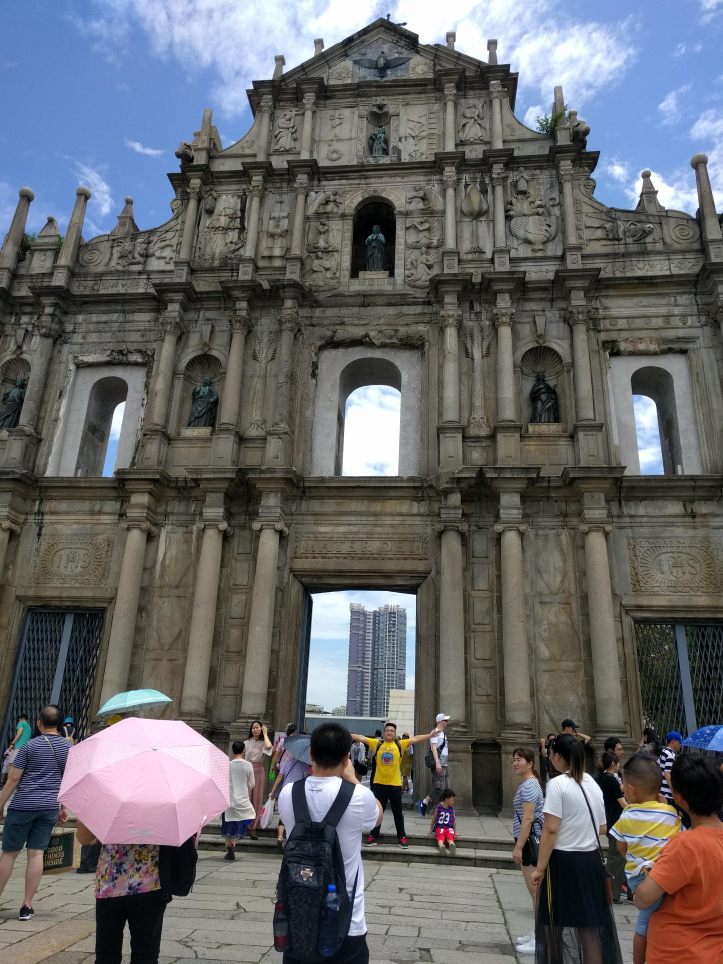
The casinos were over the top in their excess of luxury, which was impressive to look at, but far more interesting was the old sections of the city. The weathered and worn brightly colored buildings, tile, and shuttered windows gives a different vibe to the city. There is an interesting mix of Catholic influence from the Portuguese colonizers. I think this is what truly makes Macau seem so different from the rest of Asia. We also visited the lighthouse, which they still use today. You can see the buildup of the city because there are many buildings that over shadow this lighthouse, but the view of the city from here is a sight worth seeing (the first picture in this entry I took from the lighthouse). I found myself taking many photos of the buildings. I am not normally one to take pictures of buildings, but I found myself pulling out my phone regularly. I could not decide which pictures to include, so I just added ALL of them in another picture slide show.
Macau we cannot wait to come back and eat/explore more!
 Ikimashou?